Organizing a conference is a complex task that requires meticulous planning and flawless coordination.
Whether it’s to share knowledge, promote an idea or bring professionals together around a specific topic, a well-orchestrated conference can have a significant impact.
However, to achieve this goal, it is essential to follow a series of precise steps that run from defining objectives to handling post-event feedback.
In this article, we will guide you through each key step to help you organize an event in the form of a conference, maximizing both the participant experience and the benefits for your organization. You will also find the budget items to plan for, a timeline from D-6 months to D+1 month, and answers to the most frequently asked questions.
TABLE OF CONTENTS
- Define the objectives of the conference
- Choose the theme and speakers
- Plan the budget and logistics to organize a conference
- Promote the conference
- Manage registrations and attendees
- Manage logistics on the day of the event
- Follow up after the conference
- Timeline: how long does it take to organize a conference?
A conference brings an audience together around one or more speakers, on a specific theme, usually over half a day or a day.
A symposium brings together specialists, often in an academic or scientific setting, to exchange through papers and debates.
A congress is a larger gathering of a community or profession, often over several days, with parallel sessions and sometimes an exhibition.
The method in this article applies to a conference as well as to a symposium. For a larger-scale event, find out how to organize a congress with inwink.
1. Define the objectives of the conference
The first step to organizing a successful conference is to clearly define its objectives.
Without a precise vision of what you want to achieve, it will be difficult to structure the event in a coherent and effective way.
Here are the key points to consider when defining your conference objectives:
a) Identify the purpose and set objectives:
Start by asking yourself this fundamental question: why organize a conference?
A conference can serve several objectives:
A clear purpose will guide all your decisions, from choosing speakers to the promotion method.
It is also important to set measurable objectives to evaluate the success of your conference.
These objectives can include the number of attendees, attendee satisfaction, the conversion rate (if the goal is commercial), or the media impact of the event.
With precise indicators in mind, you will be able not only to measure the effectiveness and the ROI of your conference, and also adjust your strategies for future events.
b) Define the target audience:
Once the main objective is defined, identify the audience you want to reach.
Is it:
- professionals in a specific sector,
- researchers,
- your customers,
- potential customers,
- the general public,
- etc.
Understanding your target audience will allow you to design relevant content. You can also adapt the conference format to their expectations and needs.
For example, a conference aimed at experts will require in-depth technical content, whereas a more general audience will prefer accessible and engaging presentations.
A successful conference starts with three written answers: why you are organizing it, for whom, and how you will measure its success.
2. Choose the theme and speakers
The choice of theme and speakers is a decisive step when organizing a conference.
A relevant theme and high-quality speakers will capture your audience’s attention, lend credibility to your event and encourage participation.
Here is how to make the best choices:
a) Select a relevant and catchy theme:
The theme of your conference must not only be aligned with the objectives you have defined, but also resonate with the expectations and interests of your target audience.
To do this, identify current topics or emerging trends in your field.
A well-chosen theme should be specific while offering enough flexibility to welcome a diversity of viewpoints. This diversity will then spark more discussion among participants.
b) Identify and contact qualified speakers:
Once the theme is defined, it is time to choose the speakers. They should be recognized experts in their field, able to bring added value to your conference.
To maximize the impact of your event, look to diversify profiles : industry professionals, thought leaders, etc.
A good strategy when organizing a conference is to include speakers with different but complementary perspectives. This will enrich the discussions and attract a wider audience.
Contact potential speakers to explain the topic of the conference and the benefits of taking part (visibility, networking, etc.).
Explain to them clearly what you expect from them (type of presentation, duration, etc.).
Easily find experts in your field through speaker matchmaking platforms. For example lespeakers.com or Wechamp. You can also run a call for abstracts (or call for speakers). Our article explains how to launch a call for abstracts.
Also make sure to respect their schedule and anticipate any logistical constraints, especially for international speakers.
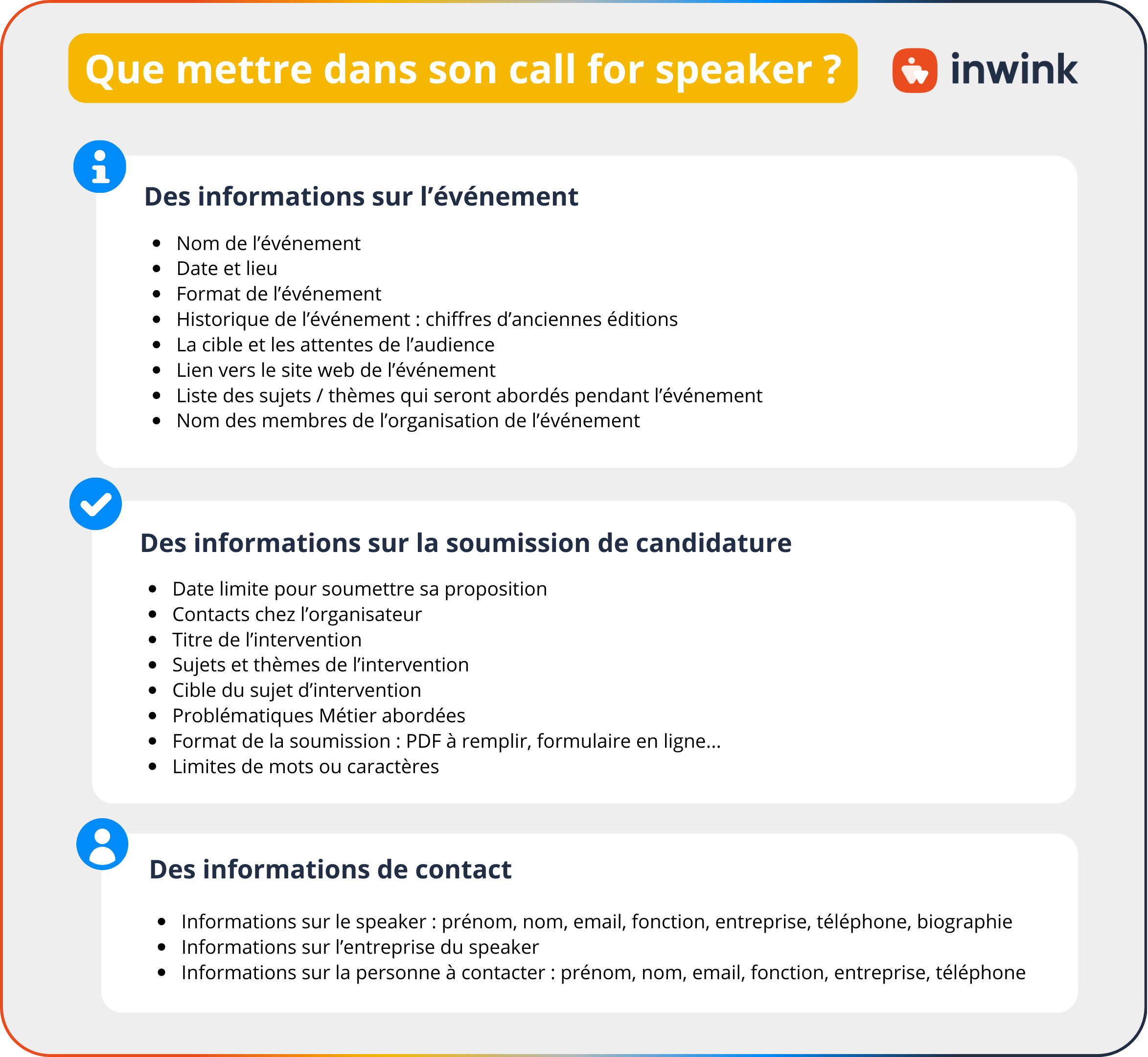
Speakers with different but complementary viewpoints make for better discussions. Specify the expected format and duration from the very first contact.
3. Plan the budget and logistics to organize a conference
Planning the budget and logistics is essential to ensure your conference runs smoothly.
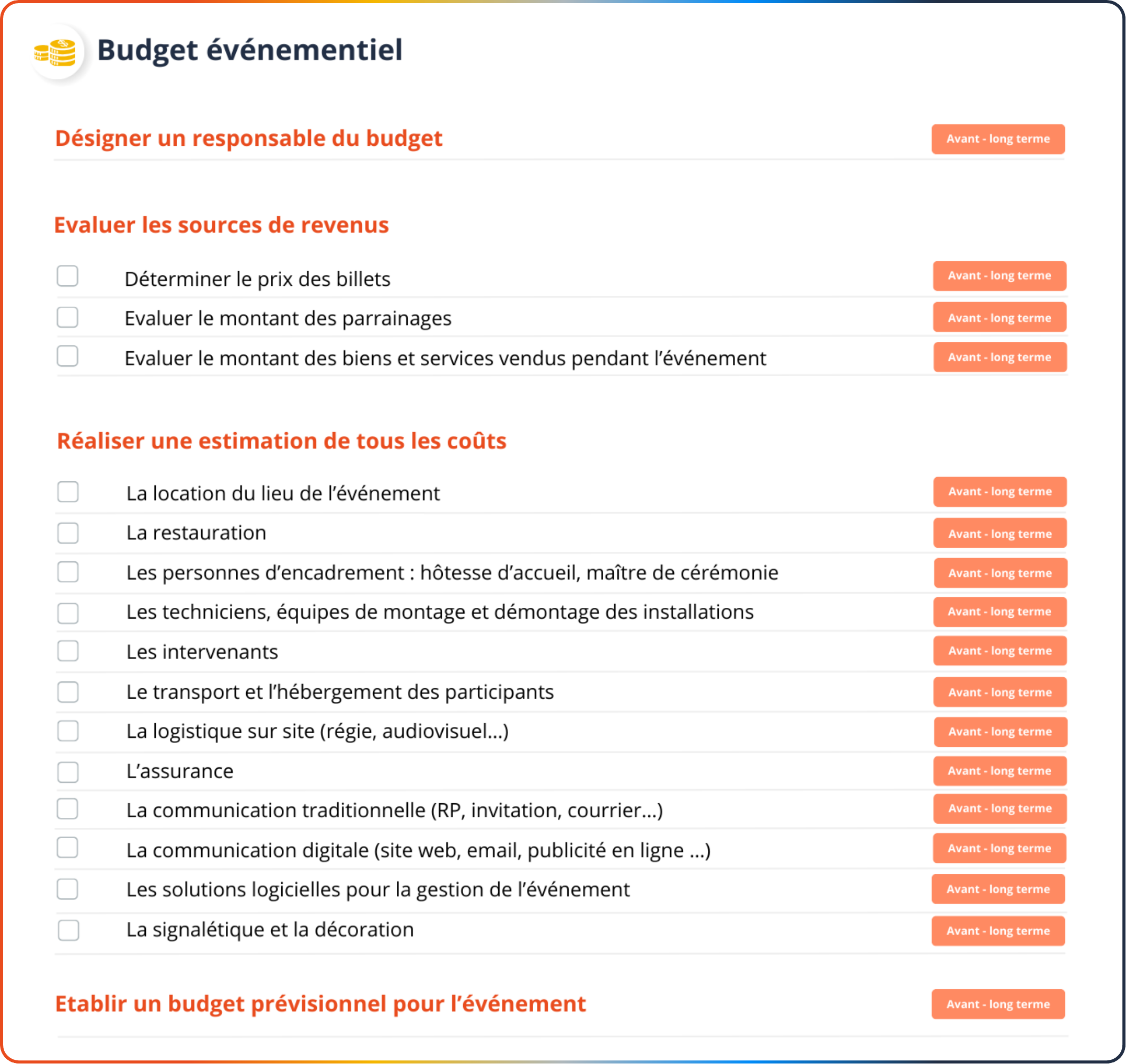
a) Conference budget: items to plan for
To establish your event budget, first list all expense items, then adjust them to the size of your conference:
| Item | What it covers | Relative weight |
|---|---|---|
| Venue | Room, reception, breakout rooms | Often the largest item |
| Technical | Sound, image, lighting, recording | Varies with equipment and recording |
| Speakers | Travel, accommodation, possible fees | Low to high depending on profiles and where they come from |
| Catering | Welcome, breaks, lunch | Proportional to the number of attendees |
| Communication | Website, visuals, emailing, advertising | Moderate, to plan from the start |
| Event tool | Conference website, registration, badges, check-in | Moderate, saves management time |
| Contingencies | Safety margin | Always to be planned |
These orders of magnitude are relative: the weight of each item depends on your format, your city and your audience. The most important thing is not to forget any. Also plan a margin for unforeseen costs to avoid unpleasant surprises.
b) Choose the date and venue, organize logistics:
Next, choose an accessible and suitable date and venue for your audience, taking into account capacity and available equipment.
Remember to organize transport and accommodation for speakers if necessary.
Finally, draw up a precise schedule for each stage of the organization, to stay organized and meet deadlines. You will find an example in the timeline at the end of the article. Good logistics management is the key to offering participants a smooth and memorable experience.
List all items before setting the budget, and keep a margin for contingencies: unpleasant surprises almost always come from a forgotten item.
4. Promote the conference
The promotion of your conference is crucial to attract participants and ensure the success of the event. To go further, find our tips on promoting your event.
a) Define the communication plan:
Start by developing an effective marketing strategy and your overall communication plan.

This communication plan can include many channels to maximize its impact :
b) Create the conference website:
Showcase the content of your conference, by creating a dedicated event website, where visitors can find all the essential information:
- The program,
- The speakers,
- Registration terms and pricing,
- Practical information,
- etc.
This website will be the showcase of the event, ideal for promoting it. But coupled with a powerful event management platform , it will also simplify the organizers’ work.

“Using the inwink platform has made us more efficient and effective in managing our conferences. The organization is smoother, our visibility is greater and the immersive experience for all participants is excellent. This strengthens our impact and our customer satisfaction.” Eva DE ALMEIDA, Communications and Events Officer at Finance Innovation
Choose few channels, but keep them going over time, with an event website as your reference point.
5. Manage registrations and attendees
Handling registrations is a key step in ensuring a smooth experience for your participants.
More details on managing registrants in our checklist for organizing an event for a conference-type event.
A simple registration and well-collected data from the start make badges, reminders and reporting easier.
6. Manage logistics on the day of the event
Organizing a conference also means handling on-site management on D-Day. And this requires meticulous organization to ensure the event runs smoothly.
a) Manage on-site logistics:
Arrive on site early to check that everything is ready : conference room, audiovisual equipment and presentation materials.
Make sure the technology works perfectly, by running sound and image tests with the speakers.
b) Handle welcome and check-in:
On the day of the conference, set up a clear and welcoming reception area. This area should offer signage and available staff to guide participants.
Set up a sign-in and badge distribution system and an efficient check-in process to register participants on arrival.
Test sound and image with each speaker before the doors open, and take care of the welcome: it is participants’ first impression.
7. Follow up after the conference
Organizing a conference also means planning for after the event ! Once it is over, a few actions remain for the organizer:
a) Measure the conference’s performance:
To analyze its success, send a satisfaction survey to your participants and gather the necessary feedback.
Produce your event reporting to understand your conference’s strengths. This will also help you identify areas for improvement to take into account for future editions.
b) Share additional content:
Organizing a conference provides you with plenty of content, especially if sessions are recorded.
From these recordings, you can create:
- 👉 Blog articles,
- 👉 Downloadable resources: ebooks, white papers, infographics, …
- 👉 Podcasts,
- 👉 Video replays and short versions of the videos, notably for social media,
- 👉 etc.
You can then:
- 👉 Distribute this content across different communication channels such as social media, press, emailing, …
- 👉 Create a dedicated online community to keep the conversations started at the conference going.
A conference doesn’t end on the day itself: the survey, the reporting and the reuse of content already prepare the next edition.
Timeline: how long does it take to organize a conference?
Allow several months of preparation. This timeline starts 6 months before the event and runs until 1 month after. The larger the conference, the earlier you need to start.
| Deadline | Key actions | Guide step |
|---|---|---|
| D-6 months | Objectives, audience, theme, budget, venue pre-booking, call for speakers | 1, 2, 3 |
| D-5 months | Speakers and date confirmed, venue finalized | 2, 3 |
| D-4 months | Conference website online, registration opens | 4, 5 |
| D-3 months | Communication plan launched, program published, first emailings | 4 |
| D-2 months | Reminders, social media, catering and technical setup locked in | 3, 4 |
| D-1 month | Speaker briefing, badges, signage, program finalized | 3, 6 |
| D-1 week | Reminder to registrants, sound and image tests | 5, 6 |
| D-Day | Welcome, check-in, on-site animation | 6 |
| D+1 week | Satisfaction survey, thank-you messages | 7 |
| D+1 month | Reporting, content and replays | 7 |
The first three months decide success: speakers, venue and the opening of registrations are settled before D-3 months.
FAQ: Organizing a conference
How long does it take to organize a conference?
Ideally allow 6 months for a medium-sized conference. A simpler internal format can be prepared faster; many speakers, especially international ones, require more time.
How many speakers should you plan for?
There is no ideal number: it all depends on the duration and format. It is better to have a few speakers with complementary profiles, with time for discussion, than speaking slots that are too short.
How do you choose the venue for a conference?
Check the capacity, accessibility, audiovisual equipment, the possibility of housing speakers nearby and availability on the target date.
What tools should you use to organize a conference?
An event website to present the program, a platform to manage registrations, badges and check-in, an emailing tool for reminders and a satisfaction survey. A platform like inwink lets you centralize all of these.
Conclusion
Organizing a successful conference relies less on talent than on anticipation : clear objectives, a budget with nothing forgotten, a timeline you stick to and a follow-up after the event.
To take action, download our checklist for organizing an event, or find out how inwink simplifies managing your conferences, from promotion to registrations.